
Documentary & Investigations
Yunnan Asian Elephants Head North: A Life Corridor and a Path of Human-Elephant Coexistence Walked Out by a Wild Herd
1. Footsteps in the Night
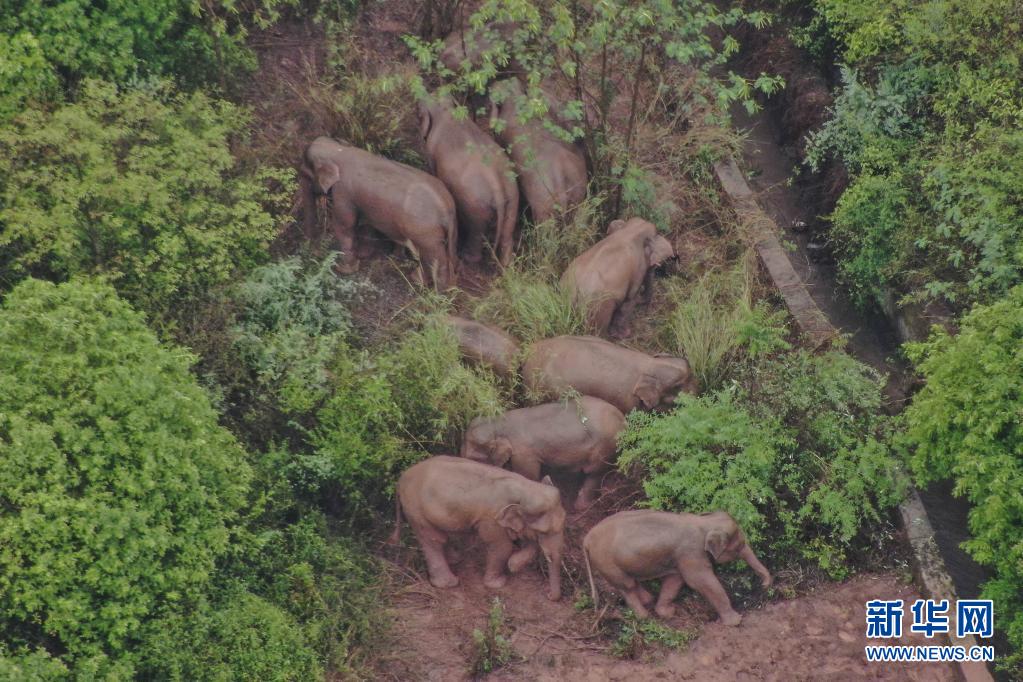
In Yunnan in 2021, many people saw Asian elephants for the first time not in a zoo, a textbook, or tourism promotion, but in frame after frame of aerial footage: a herd of massive gray lives moving slowly along the edges of mountains, villages, cornfields, and tea gardens, sometimes stopping to rest during the day and continuing on at night. Drones kept their distance in the air; on the ground were vehicle teams, warning lines, staff persuading people to leave, food-based guidance, and temporary traffic controls. They were not a performance troupe arranged by humans, but a real herd of wild elephants. Each step they took pressed into a piece of land in southwest China that was changing rapidly.
Later, the public gave them many names: the northward-migrating elephant herd, the Broken-Nose Family, the traveling elephants. The names carried a sense of intimacy, but they could not make the problem lighter. The herd traveled from Pu’er and Yuxi all the way to the edge of Kunming, then returned south under monitoring and guidance from multiple parties, crossing the Yuanjiang River back toward relatively suitable habitat. On the surface, this was a rare animal migration; looked at more deeply, it was like an unspoken question: when the traditional habitats of large wild animals are cut apart by villages, farmland, commercial forests, roads, and reservoirs, where can they still go? When a herd of elephants truly enters everyday human life, are humans willing to leave them a path?
2. Why Did They Leave?
On the reasons for the northward migration, public reports and expert explanations did not compress the answer into a single sentence. Some discussed dispersal pressure after population recovery; some discussed changes in habitat quality and food structure; some discussed exploratory behavior among younger individuals in the herd; and others reminded the public that Asian elephants naturally move continually among seasons, food, and a sense of safety. This site does not write any one explanation as the only conclusion, because migrations by large animals are often not triggered by a single switch, but are the result of many factors layered together.
Yunnan’s Asian elephants are mainly distributed in Xishuangbanna, Pu’er, Lincang, and other areas. They need large expanses of forest, bamboo forest, shrubland, grassland, water sources, and connected passages. But in areas where human use keeps intensifying, what elephants can eat has also changed: bananas, corn, sugarcane, pineapples, and fresh plants along rubber-forest edges may all be more concentrated and more energy-rich than food that is hard to obtain under natural forest. For people, these are crops and income; for elephants, they are food patches that can be smelled, seen, and reached along the way. Conflict often begins here.

3. The Herd Is Not a News Symbol, but a Family
When watching aerial footage, what often moves people most is not how large the elephants are, but how they care for one another. Adult elephants surround calves, place the young in the middle when they stop to rest, and keep formation when moving through unfamiliar areas. A herd is not a pile of independent individuals; it has kinship, order, memory, and also the curiosity and instability of younger members. If humans see them only as intruders, these social relationships disappear from view; if humans see them only as adorable internet celebrities, their real needs as wild animals disappear just as much.
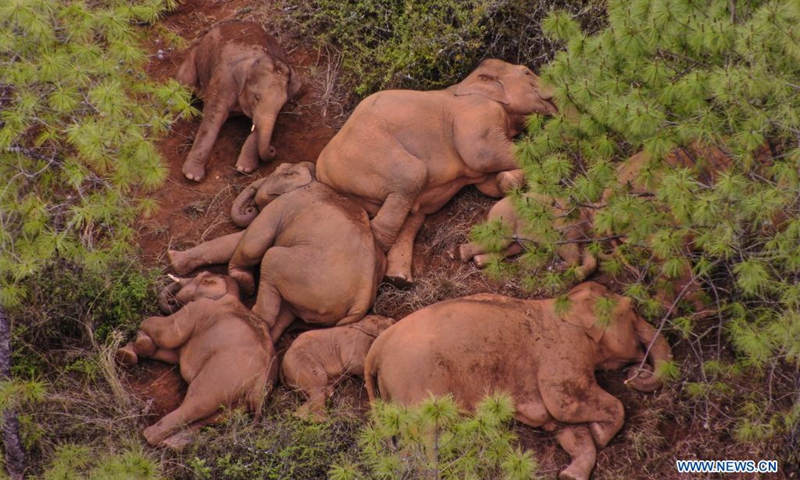
Asian elephants are among the land animals that need the most space. They can move long distances in a day, eat enormous amounts, and also need water. Calves learn routes, food, and risks by relying on adult females and group experience. During the northward migration, the public saw calves sleeping, walking, and crossing roads under the protection of the group. That was not merely a cute scene, but a wild-animal family trying to remain whole in an unfamiliar human landscape. The more they resemble a family, the more clearly they show that humans cannot respond to them only with driving away, blocking, and watching.
4. Drones, Trucks, and a Road Held Open
One of the most record-worthy parts of this northward migration is that human society did not simply push the herd toward violent conflict. In public reports, Yunnan organized measures including drone monitoring, ground tracking, temporary road controls, crowd evacuation, food placement for guidance, and temporary isolation facilities. Many workers kept watch in shifts at night, both to prevent elephants from entering densely populated areas and to keep crowds from disturbing the herd. Protecting large animals is not a matter of standing far away and shouting one sentence about kindness to life; it requires lowering every point of risk in a complex field situation.
This emergency response was not a perfect answer, but it showed a bottom line: when wild animals enter dense human areas by mistake, the first thing to protect is life, including human life and animal life. The herd might trample crops, damage walls, and create traffic risks; but as long as the logic of response shifts from killing and retaliation to monitoring, guidance, compensation, and avoidance, human-elephant conflict has a chance to be reduced to a tolerable range. The herd’s eventual safe return south was itself an outcome jointly completed by social governance and wildlife protection.
5. Farmland Is Not the Enemy; It Is Also a Clue
From the villagers’ perspective, the herd’s passage was not a romantic story. Flattened corn, eaten crops, and damaged doors, windows, and fences are all concrete losses. Ecological documentary writing cannot stand only on the animals’ side and portray ordinary farmers as people without sympathy. Many villages have lived here for generations, and land is the source of household income. When the herd arrives, people dare not go out at night and worry about the crops in their fields during the day. This pressure is real.
But farmland also provides another clue: why are wild elephants willing to come close? When natural food in forests is insufficient, corridors are cut apart, and crops are more concentrated than wild plants, elephants follow food. Human-elephant conflict is often not a matter of bad people or bad elephants, but of land-use patterns pushing both sides to the same table. Truly mature protection should include reasonable compensation, warning systems, ecological buffer zones, alternative planting, community participation, and long-term corridor planning, rather than only putting out fires temporarily after conflict occurs.
6. The Yuanjiang River Is Not the End, Only a Breathing Space
In August 2021, public reports showed that the northward-migrating Asian elephant herd crossed the Yuanjiang River under guidance and gradually returned to areas more suitable for activity. Many people breathed a sigh of relief, as if they had finally reached the ending of a feature-length film. But for Asian elephants, the Yuanjiang was not the end of the story, only a pause after one risk had been defused. They will continue to look for food, water, and safe space, and other elephant herds will also move through different areas of southern Yunnan.
The easiest misunderstanding in ecological protection is to treat one successful response as proof that the problem has been solved. In fact, after the northward migration, the issue of human-elephant coexistence did not disappear. Xishuangbanna, Pu’er, and other places still need to monitor herd dynamics, still need to handle crop losses, and still need to find more stable boundaries among villages, roads, commercial forests, and protected areas. One southward return made the public remember elephants, but it cannot replace long-term institutions.
7. The Other Side of Population Recovery
From a conservation perspective, China’s Asian elephant population has recovered compared with several decades ago, and that is a fact worth cherishing. That a once-threatened species can increase shows that hunting bans, protected-area construction, public awareness, and law enforcement have indeed played a role. But when large animals recover to a certain number, new questions follow: can already limited habitat carry more individuals? Will younger elephants disperse? Will overlap between human activity areas and elephant activity areas intensify?
This is not a failure of conservation, but conservation entering a more difficult stage. Early protection often means keeping a species from disappearing; the next stage is allowing it to continue living without being hated by humans. Asian elephants are not small animals that can be placed in enclosures. They need space at the scale of landscapes. To protect them, forests, river valleys, corridors, and community relationships must be protected at the same time. Population recovery is not the endpoint; it is the beginning of a demand that humans develop a higher level of coexistence capacity.
8. Habitat Fragmentation Is an Invisible Wall
For large animals, the most frightening wall is not necessarily a concrete wall. Sometimes it is an expressway; sometimes continuous farmland; sometimes a bottleneck formed by rubber plantations, tea gardens, villages, and fences; sometimes nighttime lights and continuous human voices. A map may still appear green, but if the green spaces are not connected, they are like islands to an elephant herd. The elephants must pass through human areas to move from one food patch to another water source.
This is why ecological documentary writing must write about migration corridors. Protected areas themselves are important, but the connections among protected areas are equally important. Animals do not recognize administrative boundaries, and they do not act according to human planning maps. Their routes are made of water sources, slopes, vegetation, smells, memory, and food. If humans keep only several isolated patches without giving them safe corridors for passage, conflicts will appear again and again.
9. Human-Elephant Conflict Is Not About Who Wins
The term “human-elephant conflict” can easily make people think the two sides are competing for victory. But real conflict usually has no winner. People may lose crops, property, or even lives; elephants may be driven away, injured, or led into dangerous zones; calves may be separated from the group amid disturbance; and villages may live for a long time in fear and resentment. If governance relies only on temporary driving away, contradictions will keep accumulating.
A better direction is to view conflict as a warning: land arrangements here have already placed people and elephants too close together, food attraction is too strong, avoidance space is too limited, information is transmitted too slowly, and compensation mechanisms are not smooth enough. Warning systems, drones, infrared cameras, village-level notices, insurance compensation, crop adjustment, and ecological corridors are not individual cure-alls, but only in combination can they turn conflict from a dangerous incident into a manageable coexistence challenge.
10. Why Did the Public Care So Much?
The northward-migrating herd drew nationwide attention not only because it was unusual. The elephants were like a mirror, allowing urban residents, rural residents, conservation workers, and ordinary children to see the same question at once: what kind of land do we actually share with wild animals? People liked watching elephants sleep, bathe, and bring calves along because there was kinship, order, and the clumsy cuteness of life there; people worried about them entering cities, being hit by vehicles, or being disturbed by crowds because there was real danger there too.
This attention has value, but it also needs guidance. Watching must not become chasing, affection must not become feeding, and traffic must not override safety. What wild animals need most is not to become internet celebrities, but to keep their wildness and distance. What the public can truly do is support scientific protection, understand compensation and avoidance measures, reject treating wild animals as entertainment, and avoid stirring up retaliation when conflicts occur. Liking a herd of elephants should ultimately mean giving them space.
11. The 42-Elephant Herd in 2024 Reminds Us
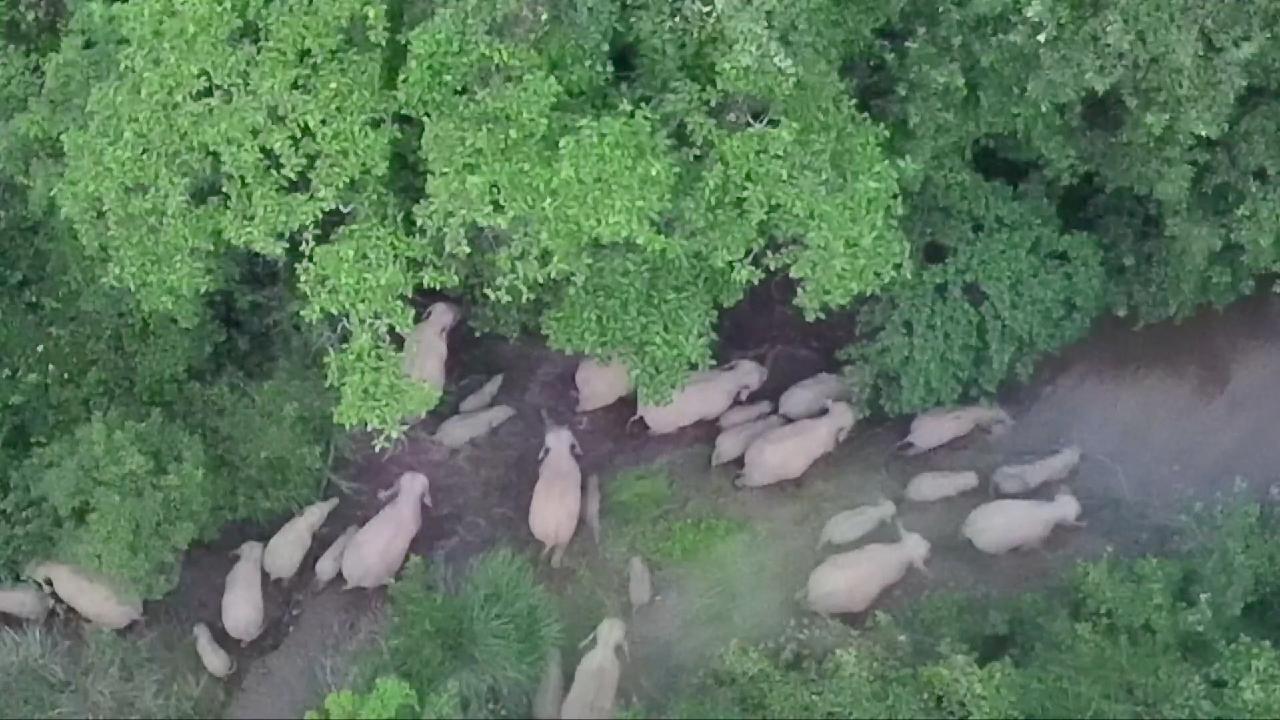
In 2024, public reports by CGTN and others showed a monitored group activity of 42 wild Asian elephants in Mengla County, Yunnan, including multiple calves. Although this scene came several years after the 2021 northward migration, it belongs to the same long thread: Yunnan’s Asian elephants are still reproducing, moving, and using landscapes where humans and forests interlace. The appearance of calves is heartening, and it also means the future will require more space, food, and safe corridors.
A herd being photographed is not only ecological news. It means the monitoring system is still operating, and it also means the pressure of human-elephant coexistence is still present. The healthier the herd, the more advance planning is needed; the more calves there are, the less society can rely only on blocking after the fact. Protection of large animals cannot begin only when they walk into villages. It should be completed in advance through habitat quality, corridor connectivity, community compensation, and public education.
12. Asian Elephants Are Engineers of the Forest
Asian elephants are not ordinary residents of the forest. They break branches, open small paths, disperse seeds, change vegetation structure, and also influence the living spaces of other animals as they feed and move. For forests, elephants are both consumers and shapers. They eat fruit and carry seeds far away; paths they tread may continue to be used by smaller animals; canopy openings they create may also allow new plants to receive light.
Therefore, protecting Asian elephants is not only protecting a flagship species; it is protecting an ecological process. Without elephants, forests lose a large transporter and path-maker. If elephants are trapped in fragmented habitats, they are pushed from ecological engineers into creators of farmland conflict. When humans leave them enough space, they are in fact also leaving forests the power to continue changing and renewing.
13. Night in the Village
Imagine a night in a Yunnan village: news arrives that the herd may be approaching, village cadres remind households one by one, elders and children return indoors first, someone keeps watch at the road entrance, and positions keep updating on phones. From the forest edge in the distance comes the sound of branches breaking, and no one knows whether the elephants will change direction. For people in cities watching a livestream, this is a spectacle; for people in the village, it is pressure, risk, and an interruption of everyday order.
Ecological documentary writing must include this night. Only by seeing villagers’ fear and losses can protection avoid becoming a weightless moral demand. And only by seeing the herd’s innocence and needs can governance avoid sliding toward retaliation. Real human-elephant coexistence means building institutions between these two perspectives: giving people compensation, warnings, and a sense of safety; giving elephants corridors, food, and space where they will not be harmed.
14. Leaving Roads for Large Animals
Many animal-conservation issues eventually return to the same word: roads. Tibetan antelopes need migration routes, migratory birds need flyways, and Asian elephants also need roads of their own. A road is not necessarily something paved by humans. It may be a continuous forest, a river valley, a chain of ridges, a low-disturbance mosaic of farming and forest, or it may be passages under highways and avoidance space between villages.
Leaving roads for large animals means development planning must ask in advance: is this a place animals often pass through? Will roads cut off corridors? Will fences force elephants into villages? Will commercial forests and farmland create strong food attraction? If these questions are ignored at the planning stage, emergency response will later require much higher costs. The lesson of the northward-migrating herd is precisely that it turned these invisible routes into routes visible to the whole country.
15. Technology Helps, but Technology Is Not Everything
Drones, infrared cameras, positioning systems, warning platforms, and big data are very important for human-elephant coexistence. Without monitoring, staff would find it difficult to know the herd’s position in time; without warnings, villages could not avoid risks in advance; without data, long-term corridor planning would lose its basis. During the northward migration, technology allowed humans for the first time to watch a herd of wild elephants continuously in a relatively restrained way and to minimize direct contact.
But technology cannot replace land choices. Drones can see where elephants are, but they cannot create habitat out of thin air; warnings can help villagers avoid danger, but they cannot eliminate crop attraction; positioning can record routes, but it cannot automatically repair broken corridors. Real solutions must combine technology with land use, community compensation, protected-area management, and public education. Technology is responsible for seeing; institutions are responsible for making way.
16. Why This Site Includes This Chronicle
This site includes the northward movement of Yunnan’s Asian elephants in its ecological guardianship chronicles not to repeat a past trending news story, but to preserve the long-term questions behind it. The animal-harm archive records how humans harm life, animal stories record rescue and companionship between people and animals, and ecological guardianship chronicles record whether humans are willing to correct, at a larger scale, the ways they occupy land.
The northward herd made no accusation and gave no speech. They simply walked through villages, farmland, river valleys, and roads, showing people a life corridor that had been cut apart. They help us understand that protecting animals is not only condemning cruelty after harm occurs, but also leaving space for life before harm occurs. Whether Asian elephants can live safely depends on whether humans acknowledge that land does not belong only to humans.
17. Unfinished Lessons
After the northward migration passed, many questions still had no simple answers. If the Asian elephant population continues to recover, how should habitat be expanded? How should traditional activity routes be identified and protected? How can farmers’ losses be compensated more promptly? Which crops should be adjusted? How can villages coexist with elephants without panic? Can land outside protected areas also carry ecological functions? All these questions require long-term investment.
More importantly, public memory must not remain only at “that cute herd of elephants.” Cuteness is not the reason they deserve the right to survive; wild life itself is the reason. Even if they trample crops, even if they do not follow human routes, even if they bring management costs, they should not be hated for it. Human maturity is reflected in whether we can design a form of coexistence, not premised on elimination, for lives larger, quieter, and more dependent on space than ourselves.
18. Finally, May They Still Have Forests
If people look back years from now at the 2021 aerial footage, they may remember the herd sleeping in a cluster on the grass, with calves surrounded by adults. That scene is unforgettable because it turned wild animals from an abstract noun into concrete lives. They get tired, protect young, lose their way, search for food, and rely on one another in an unfamiliar world.
May Yunnan’s Asian elephants still have forests, river valleys, grasslands, and water sources; may villages have safety and compensation; may roads leave gaps for migration; may public enthusiasm eventually become rational protection. We record this herd not to keep them forever in the news, but to remind ourselves: when a herd of wild elephants writes a road with its footsteps, humans should at least read it seriously.
19. Between Rainforest, Bamboo, and Commercial Forests
To understand Yunnan’s Asian elephants, we cannot look only at the boundaries of administrative protected areas; we must also look at the surface they truly pass through. Tropical monsoon rainforest, bamboo groves, secondary forest, tea gardens, rubber plantations, cornfields, banana fields, and village edges interweave to form the real map of today’s elephant activity. To people, these parcels belong to different operators, villages, and management departments; to elephants, they are simply a connected series of spaces where they may or may not walk, eat, find water, or face danger.
Commercial forests and farmland are not naturally wrong; they carry local livelihoods. But when large areas of single-species commercial forest replace more complex natural vegetation, forest structure becomes thinner, and the seasonality and diversity of wild food decline, making animals more easily attracted by crops. The northward migration matters because it turned this structural change into a scene the public could see: the herd did not suddenly intrude into the human world, but continued forward along food, slopes, and corridors after the human world kept extending into their range of activity.
20. Compensation Systems Are Also Protection Systems
Many people like to talk about compassion when discussing protection, but overlook compensation. For farmers living in elephant activity areas, if losses are not compensated promptly, fairly, and transparently, protection is easily understood as making a few people bear costs for all of society. Crops being eaten, walls being damaged, and nighttime travel being restricted are not abstract annoyances, but issues of cash income, household safety, and everyday order.
Therefore, compensation is not a compromise against protection, but part of the protection system. The more a society hopes wild animals will be treated kindly, the more it should take good care of the people who live next to them. Insurance, fiscal subsidies, rapid damage assessment, village-level consultation, and alternative livelihoods can all reduce resentment. People’s willingness to make way for elephants often depends on knowing their losses will not be lightly brushed aside with the sentence, “you should have compassion.”
21. From Watching to Participating
During the 2021 northward migration, many people tracked the herd’s position through videos and news, as if following a serial drama. Public attention brought Asian elephant conservation into such broad everyday discussion for the first time, but it also brought new risks: some people approached out of curiosity, some tried to film, and some treated wild elephants as a check-in subject. For large wild animals, excessive watching is itself pressure and may even change their routes and increase the probability of conflict.
Real participation should be more restrained. What ordinary members of the public can do is not follow the elephants, but understand why roads must be closed, why people must be evacuated, why feeding is forbidden, and why location information cannot be spread casually. Loving animals is proven not by getting close, but by respecting distance. The lesson the northward herd gave the public was precisely the move from “watching the spectacle” to “understanding boundaries.”
22. Responsibility Beyond Protected Areas
Asian elephants do not live only inside protected areas. Their activity range may cross nature reserves, collective forestland, farmland, roads, and villages. If management inside protected areas is good but buffers and corridors are lacking outside them, herds will still frequently enter conflict zones. This is also a problem many wildlife-conservation efforts encounter: the most critical spaces are often not the darkest-colored core zones on a map, but the neglected connections between core zones.
Therefore, human-elephant coexistence requires extending conservation responsibility to broader landscapes. Local planning, transport construction, crop layout, village expansion, tourism development, and forest management may all change elephant routes. A project may appear to occupy only a small piece of land, but cumulatively it may block a corridor. What ecological guardianship chronicles must write about is precisely this cumulative effect: no one person alone decided that the herd would move north, but many choices together shaped the world they had to pass through.
23. Calves Mean the Future, and Also Pressure
The public loves calves most because they are clumsy, round, and easy to feel tender toward. But from the perspective of conservation management, the appearance of calves is both hope and pressure. The hope lies in the population still having reproductive capacity and the group structure continuing; the pressure lies in the fact that every calf, after growing up, will need food, water, and activity space. If habitat does not improve at the same time, today’s good news may become more frequent future conflict.
So when we see calves, we cannot only say they are cute. We must also ask: where will they go after they grow up? Are the routes they learn safe? Will they treat farmland as a stable food source? Can their group avoid being divided by roads, fences, and villages? Truly responsible love means preparing a livable environment for a calf before it has grown into a giant.
24. Local Knowledge Cannot Be Replaced
In wildlife protection, scientific monitoring is important, and local knowledge is equally important. People who have lived in elephant areas for a long time know which valleys elephants often use, which road sections are dangerous at night, which crops most easily attract elephants, and which river valleys still have water in the dry season. If outside technical teams do not listen to this experience, they can easily see the map as too flat and the field situation as too simple.
During the northward migration, grassroots cadres, forest rangers, villagers, police personnel, and professional teams together formed a protection network. Some people were responsible for passing on information, some for persuading crowds to leave, some knew the terrain well, and some judged where the herd might turn. These tasks rarely appear in grand narratives, but they are the foundation of successful risk avoidance. Large-animal protection is not a project completed by a few experts alone, but a network woven jointly from local knowledge and professional technology.
25. Do Not Tame Wildness into a Story
After the northward herd became beloved by the public, it was easy to turn them into a warm story: they were like a family traveling, like lost children going home. Such narration can bring them closer to people, but it is also dangerous. Wild elephants are not fairy-tale characters. They may collide, destroy, and attack, and they may also make unpredictable reactions when frightened. Turning wildness completely into a story makes people underestimate distance and risk.
Ecological documentary writing needs to preserve closeness and awe at the same time. We can be moved by images of the herd protecting calves, but we must also acknowledge that they are powerful wild animals; we can hope they remain safe, but we must also understand villagers’ fear; we can praise emergency response, but we must also ask about long-term corridors and habitats. Only by not flattening wildness can protection avoid becoming another form of consumption.
26. Seeing All Large Animals Through Asian Elephants
The northward movement of Yunnan’s Asian elephants was not an isolated event. Around the world, large animals face similar difficulties: habitats are cut apart, migration routes are blocked by roads and farmland, contact with human industries increases, and successful protection brings new spatial pressure. Whether elephants, tigers, bears, wolves, Tibetan antelopes, or migratory birds, they eventually bring the same question before humans: how much space are we willing to leave for them?
This question has no cheap answer. Leaving space means planning costs, compensation costs, and management costs; it also means humans cannot push every piece of land toward the highest-intensity use. But without this concession, so-called animal protection can only remain at the rescue end. The real legacy left by the northward herd is not a spectacular video, but a long-term exam question: do humans have the capacity to think about development, village safety, and wild-animal survival on the same map?
27. This Site’s View
This site records the northward movement of Yunnan’s Asian elephants because it showed the core of ecological protection in a rare and clear way: animals are not isolated individuals; behind animals are habitats, food chains, migration corridors, village livelihoods, and institutional choices. Protecting a herd of elephants is not only preventing them from being killed, nor does it end with sending them back to some seemingly suitable place. It requires long-term repair of the relationships cut off between them and the land, and between them and human society.
We appreciate the handling of the northward migration that tried hard to avoid harm, and we also hope the public can turn its affection for this herd into more mature ecological awareness. May every act of watching become understanding, every worry drive institutional improvement, every loss be fairly compensated, and every road walked out by elephants remind humans that treating life kindly happens not only in moments of emotional intensity, but also through the long years in which roads, farmland, forests, and villages are planned anew.
28. The Plant Community Behind an Elephant Path
The road elephants walk is not only a trace pressed into the ground; it is also a clue to changes in plant communities. Asian elephants have a broad feeding range, and bamboo, herbs, tender branches, bark, fruit, and crops may all enter their diet. If an area has rich understory plants in natural forest, sufficient seasonal fruit, and stable water sources, elephants have more reason to remain in the wild. If natural food is insufficient while corn, bananas, and sugarcane around villages are easier to obtain, they will approach humans more and more frequently.
Therefore, restoring elephant habitat cannot mean only “plant more trees.” More important is restoring complex plant communities: trees to form shade, shrubs to provide cover, bamboo and herbs to support feeding, river valleys and lowlands to retain moisture, and seasonal fruit to extend food supply. To humans, these may be only vegetation arrangements; to elephants, they are living conditions that determine whether they must risk entering farmland.
29. Starting with a Solitary Male Elephant
During the northward migration, public reports mentioned that a male elephant had left the group and was being continuously monitored. Leaving the group is not rare; adult or subadult males may at certain stages leave matriarchal groups and form more independent patterns of activity. But when this behavior occurs in dense human landscapes, risk rises markedly: a solitary elephant is more likely to change route suddenly and more likely to enter the edges of villages, roads, and farmland.
This reminds us that protection cannot be designed only around a single “whole herd.” Groups led by females with calves, males, and subadult individuals do not use space and risk in exactly the same ways. Monitoring systems need to identify different individual states, and community warnings must adjust according to actual locations and behavior. Truly refined human-elephant coexistence must upgrade from “elephants are coming” to “what kind of elephant, in what state, and moving through what terrain.”
30. Education Is Not a Slogan, but Daily Training
Education in elephant areas cannot rely only on a sentence on the wall saying “protect wildlife.” Villagers need to know how to avoid danger when they encounter elephants; tourists need to know they must not chase and film; children need to know wild animals are not pets; grassroots workers need clear reporting procedures. The more specific education is, the more it can reduce wrong actions at critical moments. Many conflicts are not caused by malice, but because people do not know where to retreat, whom to notify, whether they can turn on lights, or whether they can use sound to drive elephants away.
This kind of knowledge should enter schools in elephant areas, village meetings, tourism notices, and mobile-phone warning systems. It is not auxiliary publicity, but part of public safety. If a society truly chooses to coexist with large wild animals, it must turn coexistence capacity into daily training. Otherwise, every time elephants approach a village, people will again depend on temporary experience and individual courage, and risks will be magnified again and again.
31. Turning Affection into Institutional Memory
The northward herd once made many people begin caring about Asian elephants overnight. But heat fades; institutional memory must not. Which routes the herd used, which villages had high risks, where crop losses were concentrated, which guidance methods were effective, and which viewing behaviors caused disturbance should all be preserved as experience for future governance. What ecological protection fears most is every incident starting from zero; what it needs most is turning one incident into calmer preparation for the next.
This site’s article is also a small act of institutional memory. We cannot replace professional monitoring or government management, but we can preserve key facts in the public narrative: why elephants walked out of forests, how people held the bottom line, what villagers bore, what calves mean, and why corridors matter. When large animals next enter public view, people may understand more quickly that true goodwill is not brief emotion, but long-term arrangement.
32. Let the Next Encounter Bring Less Panic
The most precious legacy of the northward herd may not be those few widely circulated aerial photographs, but the fact that it made many people realize for the first time that protecting large wild animals is not a matter of distant wilderness; it can enter highways, villages, farmland, and city edges. The next encounter will still happen. It may be elephants, or it may be bears, monkey troops, wild boars, migratory birds, or other animals that are searching for space again. Humans cannot guarantee every encounter will be romantic, but they can make the next one involve less panic, less harm, and less last-minute scrambling.
To do this, the experience left by the northward migration must be carried forward: identify corridors earlier, compensate losses more steadily, monitor individuals more finely, restore habitats more seriously, and tell the public more honestly that wild animals are worthy of love and must also be kept at a distance. Ecological protection is not inviting animals back into photographs, but allowing them to live on real land. May the road this herd walked ultimately become not only a route in the news, but the beginning of humans relearning how to make way. And may this learning not stop in Yunnan, but illuminate more wild lives being pressed close by roads, lights, fences, and farmland.
Sources and Notes
Global Times: Drone team monitors the wandering elephant herd in Yunnan
CGTN: Large wild Asian elephant herd spotted in southwest China's Yunnan
IUCN Red List: Asian elephant conservation status and threats
Shaffer et al.: Human-Elephant Conflict, a review of management strategies
This article is based on public reports, materials from conservation organizations, and research on human-elephant conflict. When addressing the reasons for the northward migration, it preserves a multi-factor explanation and does not write any single inference as a confirmed fact; when addressing images, it uses only images from public pages that are directly related to Yunnan Asian elephants or subsequent monitoring, and marks source boundaries in the captions.
Remember and Respond
Offer a Flower
Anonymous flower offerings are limited by IP address to keep this public-interest website sustainable.
Messages
Approved visitor messages will appear here after review.
💬 Leave a Message
Messages are reviewed before publication. Please keep them calm, factual, and respectful.